The Multi-Outlet Restaurant Growth Playbook: Escaping the Full Tables, Empty Bank Account Trap
Weekend queues and packed dining rooms often conceal negative unit margins. Across casual dining networks and family restaurants, cash flow bleeds through 30% delivery commissions, one-off viral food vlogger spikes, and zero guest data capture at the cash register. Here is the operational system built to capture direct local demand and maximize table profitability.
A deceptive paradox traps casual dining networks, family restaurants, and heritage culinary brands once they scale past two branches.
Every weekend, dining rooms are bustling. Long queues form outside the entrance, waiting benches are occupied, and the social media team celebrates a viral video crossing one million views on TikTok. Yet at month-end, the executive dashboard reveals a sobering reality: operating cash flow is flat, margins are compressed, and the bank account balance barely moves.
The conventional response is reflexively predictable: run steeper 35% flash discounts on third-party delivery aggregators, pay another celebrity food vlogger for a dedicated review, or demand more daily short-form video uploads. None of these moves fix the business. Instead, they compound the damage by training customers to wait for discounts while surrendering healthy restaurant margins to tech platforms.
In his operating work across culinary enterprises and multi-outlet restaurants, Aditya treats this not as a lack of customer appetite, but as a severe breakdown in unit economics and intake architecture. A full restaurant can still bleed cash if its operational mechanics are engineered around low-ticket vanity rather than predictable commercial retention.
The short version
The 4-point F&B diagnostic triage
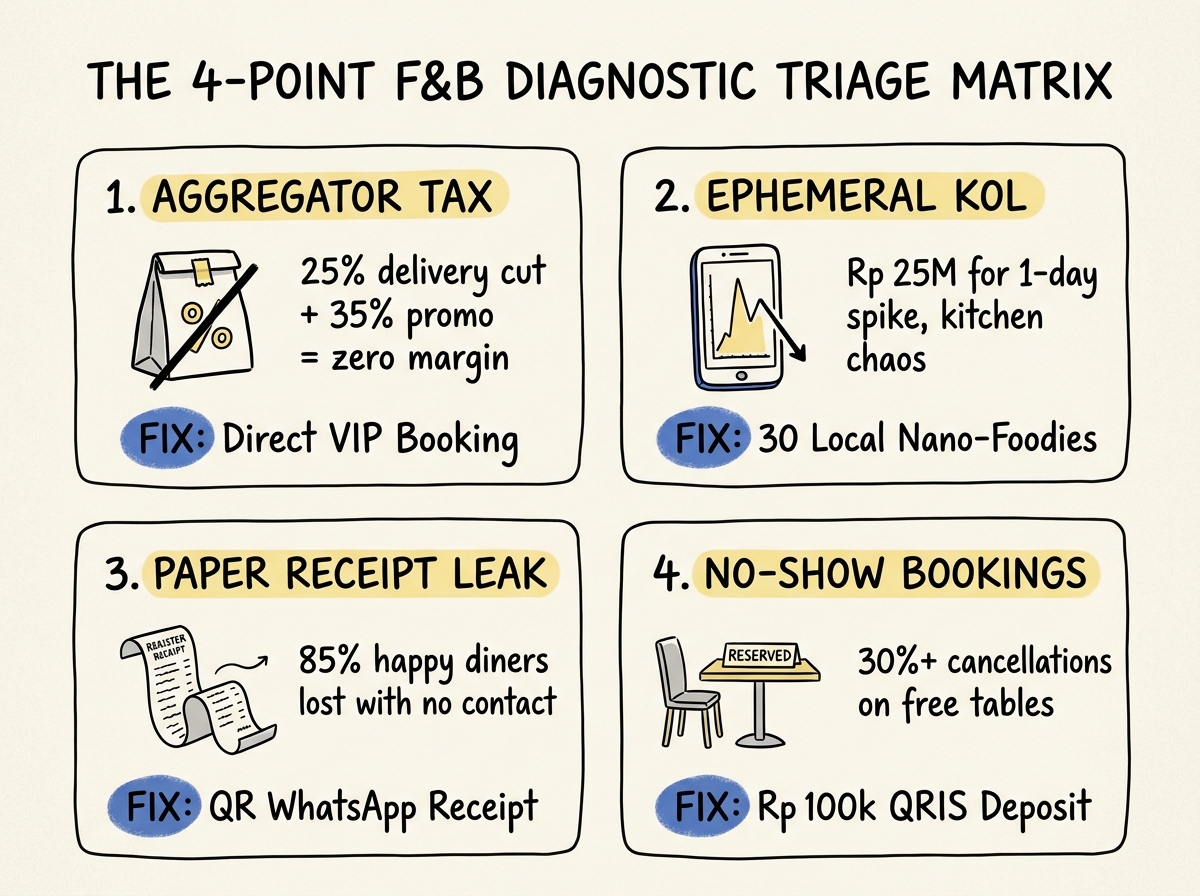
When a multi-branch restaurant experiences plateaued profits despite full weekend dining rooms, the operator must resist launching random promotional discounts. Instead, conduct an operational triage across four core friction points where culinary revenue quietly bleeds.
1. The delivery aggregator commission trap
Online food delivery platforms offer convenient distribution, but building a brand entirely dependent on aggregator algorithms is financial suicide. When an outlet offers 35% subsidized promotions on top of the platform's standard 20% to 25% commission fee, the restaurant operates at a net loss on every order packaged.
Worse, the delivery platform owns the customer relationship. The restaurant receives a ticket number, cooks the food, and absorbs raw ingredient costs, while the platform collects customer phone numbers, habits, and re-marketing rights. The operator fix is treating delivery platforms strictly as top-of-funnel discovery, while driving high-margin dine-in and direct group orders through owned local channels.
2. The macro food vlogger mirage
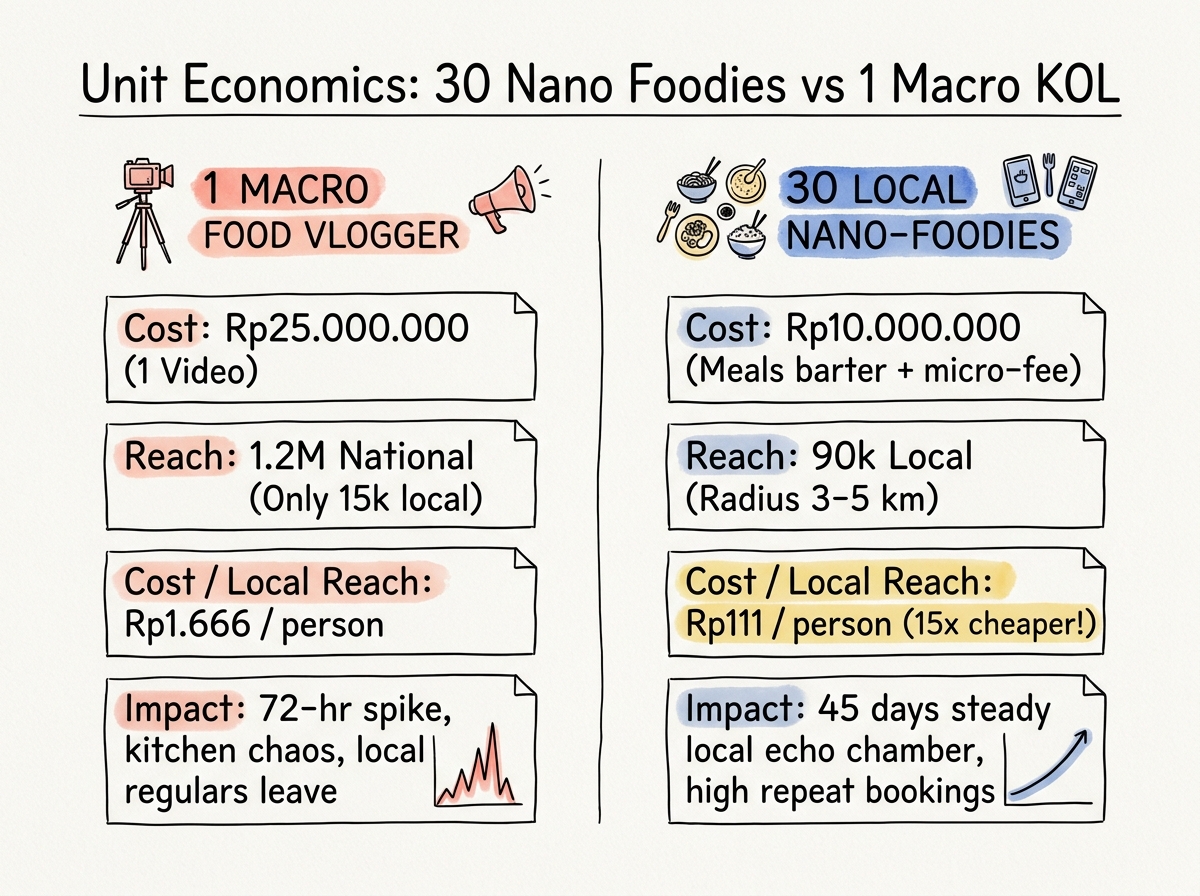
Paying Rp15,000,000 to Rp25,000,000 to hire a single celebrity food vlogger with one million followers creates an illusion of marketing triumph. The video goes viral, triggering a chaotic 72-hour operational storm that overwhelms kitchen staff and degrades service quality for regular patrons.
By day five, the hype subsides completely. The transient crowd moves on to the next viral sensation. In contrast, deploying 30 localized nano-creators (costing approximately Rp500,000 each or product exchange) generates 30 distinct user-generated assets, achieves approximately Rp909 versus Rp1,846 per engagement, and creates steady ambient frequency across local neighborhood feeds.
3. The low-AOV reliance blindspot
Many restaurant managers obsess over turning tables in 30 minutes on Rp50,000 single-diner orders. Yet high table turnover strains floor staff, creates dishwashing bottlenecks, and yields razor-thin contribution margins.
The real commercial advantage in multi-branch dining is high average order value (AOV) group reservations: family birthday banquets, corporate department lunches, arisan gatherings, and VIP private dining rooms. A single group reservation billing Rp2,500,000 to Rp5,000,000 generates the profit contribution of 40 to 50 regular tables with zero operational chaos, because kitchen prep and seating schedules are planned days in advance.
4. The cash register data black hole
The single greatest operational failure in traditional dining is letting satisfied patrons leave the building without capturing their contact coordinates. Over 85% of first-time diners never return, simply because out of sight means out of mind.
When the cashier hands over a paper receipt without an incentive to join the restaurant's direct WhatsApp VIP circle, the business resets its customer acquisition cost back to zero every single morning. Profitability requires an automated offline-to-online (O2O) recall loop that systematically brings patrons back for recurring life milestones.
Are your restaurant tables packed while your cash reserves stay flat?
If your outlets are busy but your bottom-line margins are vanishing into aggregator commissions and rising ingredient costs, the bottleneck is your intake and retention architecture. In a private 90-minute Constraint Audit, Aditya diagnoses your local geofencing, group booking funnels, and customer lifetime value to restore profitability.
The 5-stage restaurant growth machine
To build predictable multi-outlet revenue that compounds without continuous price slashing, an operator requires an integrated acquisition and retention system. The diagram below details the 5-stage culinary growth flywheel deployed across client engagements.
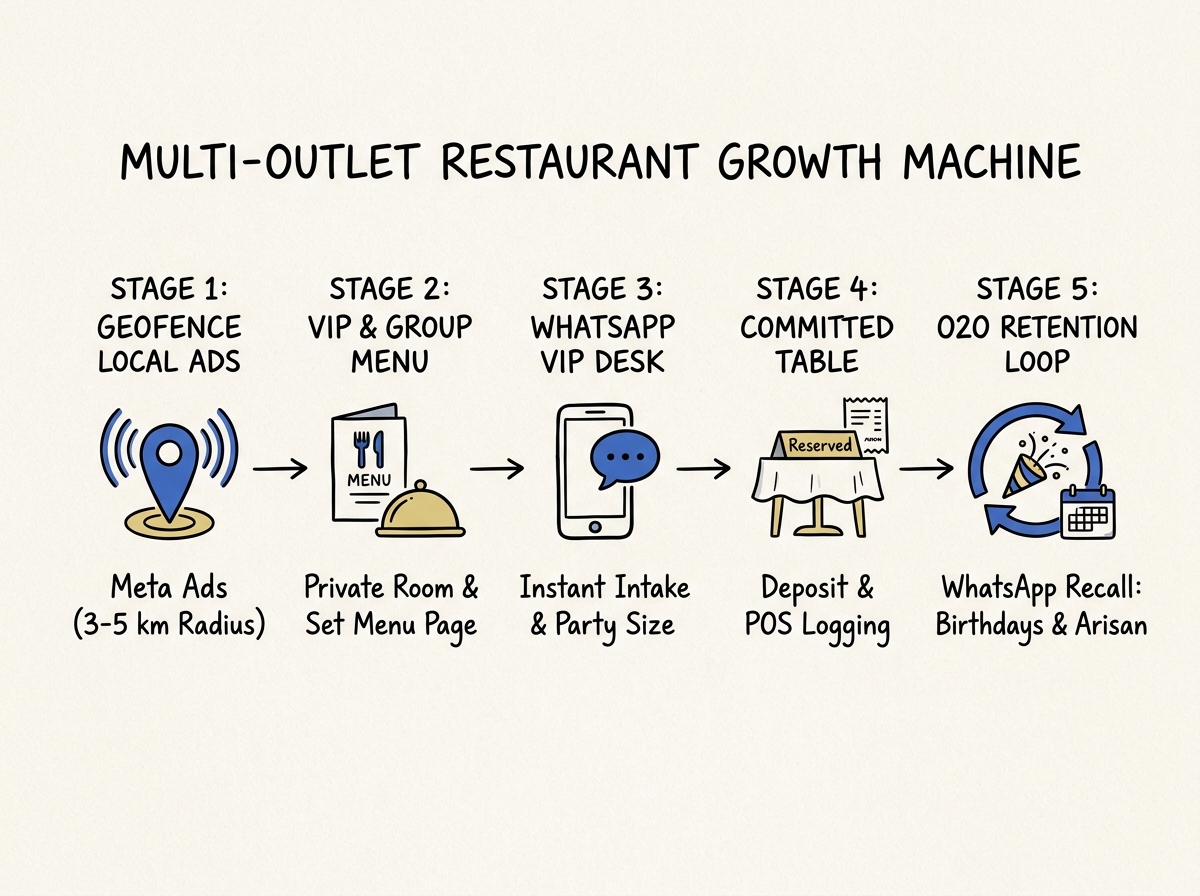
Stage 1: Promise (Geofenced Problem Ads)
Culinary advertising fails when it casts a vague net across an entire metropolitan area. High-performing outlets constrain paid media to a strict 3 to 5 kilometer radius around each physical branch, targeting specific consumer problems rather than showing generic food photography:
- The Family Coordinator Angle: "Tired of cramming 15 family members into crowded noisy tables? Reserve a soundproof VIP room with dedicated service and zero hidden room charges."
- The Corporate Event Angle: "Host your department quarterly lunch with tailored set menus, fast guaranteed serving times, and consolidated corporate invoicing."
- Weekend Celebration Intent: Targeting local residents celebrating birthdays, graduations, and anniversaries with curated group packages.
Stage 2: Proof (Decoupled VIP & Set Menu Landers)
Sending ad traffic to an unreadable 20-page PDF menu on Google Drive destroys booking intent. Instead, prospective guests land on a dedicated, focused page designed for group decision-making:
- Room and Ambience Walkthroughs: Crisp photos and 360-degree views of private dining rooms, seating capacities, and projector or audio facilities.
- Curated Set Menu Pricing: Clear per-person or per-table packages (such as Package for 6, 10, or 20 guests) that eliminate ordering confusion.
- Practical Logistics: Dedicated notes on valet parking availability, halal certification, accessibility, and outside cake or corkage policies.
Stage 3: Decision (Direct WhatsApp VIP Desk)
The bridge between online interest and confirmed dining is personal qualification. The landing page routes visitors directly to an automated WhatsApp intake desk with a pre-formatted message structure:
- Sub-60-Second Greeting: An automated assistant greets the prospective host instantly, capturing essential parameters: date, time, branch location, and guest count.
- Instant Menu Recommendations: The system presents appropriate set packages based on group size and flags dietary restrictions or special requests.
- Branch Manager Handoff: High-value inquiries are routed immediately to the branch floor manager with full booking context pre-loaded.
Stage 4: Delivery (The Committed Table Reservation)
Phantom reservations cost multi-outlet restaurants millions in idle tables during peak weekend windows. Protecting floor capacity requires an intentional commitment gate:
- Nominal Booking Deposit: Securing group reservations through a modest commitment fee (such as Rp100,000 to Rp250,000, fully creditable against the final dining bill) paid via instant QRIS or Virtual Account.
- Automated Schedule Confirmations: Automated WhatsApp reminders sent 24 hours and 3 hours prior to the reservation, including Google Maps directions and parking tips.
- POS Preference Tagging: When the host arrives, the cashier and floor captain reference pre-logged notes (such as celebrating grandmother's 70th birthday or preference for less spicy dishes).
Stage 5: Return (The O2O Flywheel & Milestone Retention)
The long-term margin of a restaurant lives in repeat dining. While email newsletters suffer from dismal 15% open rates, direct WhatsApp messaging commands open rates above 95%:
- Digital Receipt Incentive: At checkout, the cashier invites the guest to scan a QR code for an instant digital receipt and welcome voucher, capturing phone numbers cleanly.
- Automated Birthday and Anniversary Cadence: Sending personalized invitations 14 days before recorded milestones with an exclusive complimentary dessert or private room upgrade.
- Seasonal Corporate Gathering Outreach: Re-engaging corporate administrative coordinators ahead of Ramadan iftar schedules, year-end celebrations, and quarterly review seasons.
Closing the telemetry loop: Offline conversion tracking
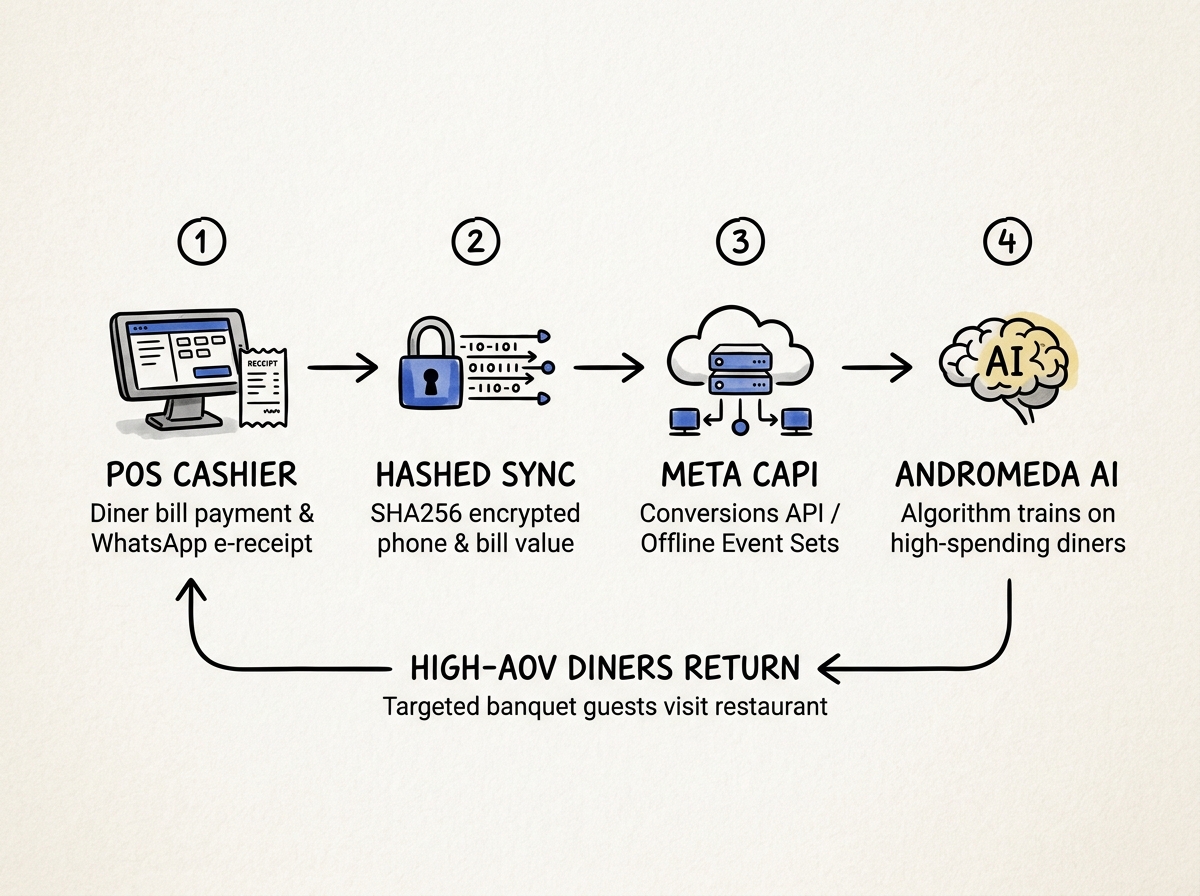
The ultimate technical edge in culinary growth is connecting in-restaurant sales back to online ad algorithms. Most restaurant owners run ads optimized merely for link clicks or profile visits, training delivery engines to deliver cheap browsers who rarely spend money.
By integrating the restaurant point-of-sale (POS) and reservation database with Meta Conversions API (CAPI) and Google Ads Offline Tracking, the operator feeds two high-value milestone events back to the algorithms every week:
- Event 1: Table_Booking_Confirmed: Triggered when a guest pays their commitment deposit for a group reservation.
- Event 2: DineIn_Invoice_Settled: Triggered when the physical bill is cleared at the cashier, transmitting real basket value.
Over 30 to 60 days of continuous data feedback, ad delivery algorithms recalibrate away from low-intent teenagers and automatically allocate budget toward high-spending local family coordinators and corporate event planners, driving down customer acquisition cost while lifting average ticket size.
Proven operator benchmarks
When this operating architecture was executed for heritage multi-branch dining groups like Angke Restaurant and casual dining networks in Indonesia, the performance outcomes spoke with concrete precision:
The 30-day operator execution plan
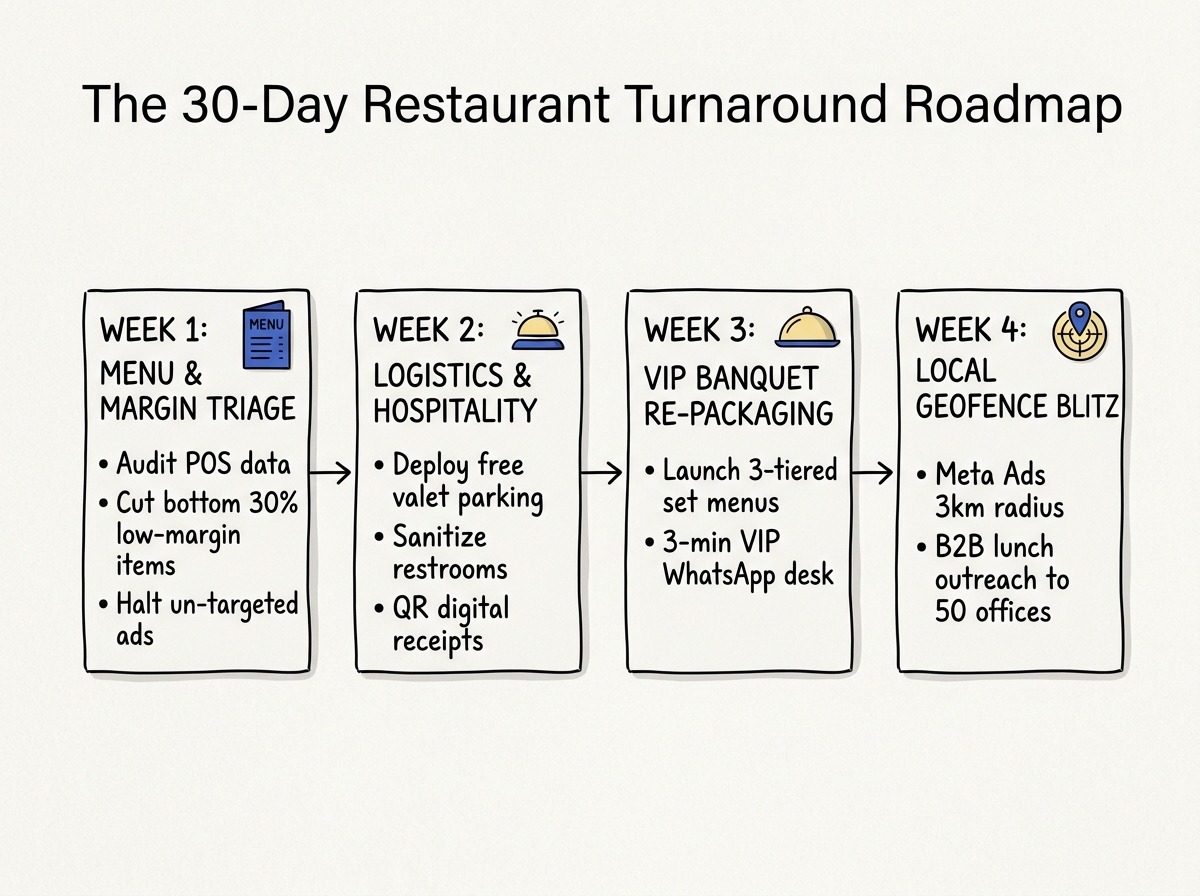
For culinary founders, managing directors, and marketing heads ready to transition from chaotic promotion to systematic retention, Aditya outlines a disciplined four-week roadmap:
- Week 1 (Unit Economics & Intake Audit): Calculate true net margins after aggregator fees, stop loss-making promotions, and implement cash register phone number capture protocols.
- Week 2 (Frictionless Group Funnel): Build dedicated mobile landing pages for VIP rooms and banquet set menus with direct pre-populated WhatsApp reservation links.
- Week 3 (Geofenced Demand & Nano Whitelisting): Launch 3 km Meta geofenced campaigns targeting group coordinators, paired with whitelisted content from 30 local nano-foodies.
- Week 4 (Telemetry & Recall Automation): Connect POS settled invoice data to Meta CAPI and activate automated WhatsApp milestone re-engagement sequences.
Operating a thriving restaurant network is not about chasing the latest TikTok food stunt. It is a predictable discipline: capturing local demand directly, locking high-AOV table reservations with mutual commitment, and turning first-time diners into lifelong brand regulars.
Reported F&B client figures reflect contributions to team outcomes during the engagements described, not sole-authored results. Work delivered via Calibreworks and We Are Infiniti.

Aditya Indra Bayu
·Fractional CMO · InfinitiLabsAditya builds and operates commercial growth engines from the inside. He connects positioning, funnels, paid media, and sales telemetry until the business finds durable revenue.